Marie-Amélie LAUZANNE, a sociologist, has examined—together with the PrescAPP collective—the social determinants of engaging in physical activity among ageing individuals; such engagement often appears linked to socialization into sport during childhood or adolescence. Here, she explores how the medical prescription scheme for “adapted physical activity” (APA) may have encouraged participation among people who had previously remained distant from such practices.
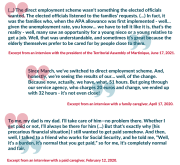
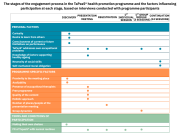
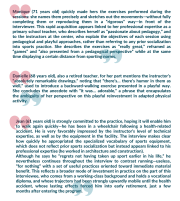
Introduced in 2016, APA programs are secondary prevention schemes, generally short-term, designed to facilitate engagement in “ordinary” physical activity. As part of the PrescAPP collective, around fifty interviews were conducted with APA participants over the age of 55 across five regions. The majority of program participants had not previously engaged in physical or sporting activities. The interviews show that, for them, medical prescription facilitated participation, which no longer appeared so much as “sporting” but rather as “medical.” The interviews also reveal that, for some, their subjective commitment to the activity is shaped by representational and perceptual frameworks developed through their professional lives: former primary school teachers valuing the instructors’ pedagogical approach, a former construction site manager emphasizing strength-based work, and so on.
Far from calls for “active ageing” which seek to extend a notion of “usefulness” modeled on the world of work, and despite forms of disengagement from work that often precede retirement, the reactivation of subjective frameworks linked to professional experience appears to encourage engagement in new activities in later life.
Statut : Docteure en sociologie
Affiliation : chercheuse associée au Centre Max Weber
Presentation of the PrescAPP collective: The PrescAPP collective brings together university lecturers and researchers, contract researchers, and students from the social sciences and the field of Sport Sciences (STAPS). It examines the implementation and reception of public and private policies and initiatives related to the medical prescription of physical activity, following its incorporation into law in 2016.
Lien : https://www.msh-lse.fr/projets/prescapp/
Collectif PrescAPP. (2025) « Fatphobia and physical activity from the coconstruction of stigma to the potential for change », Journal of Gender Studies. http://dx.doi.org/10.1080/09589236.2025.2560389
Collectif PrescAPP. (2025), rapport de recherche : « Une (petite) mesure de santé publique. Politiques et usages de la prescription d’activité physique auprès de personnes vieillissantes », 290 p. https://hal.science/hal-05163313v1/file/PrescAPP%20rapport%20scientifique%20complet%202011009-00.pdf
Collectif PrescAPP. (2025). « Comment s’exprime l’ethos de service public ? Positionnements et pratiques des cadres intermédiaires du secteur public dans la mise en œuvre des politiques d’activité physique à des fins de santé », Travail et Emploi (à paraître).